
Knee Pain? Stop Looking at Your Knee!


Ican’t tell you how many times I’ve heard somebody tell me that they have “badknees.” Well, your knees may bother you, butI’m here to say that your knees are probably not the problem. In actuality, your knees are most likely doingeverything right, but you have bad hips (or ankles).
Ishould make clear that there are exceptions, and I will not be talking aboutany knee issues that may have developed from a contact injury (like havingsomeone headbutt your knee, shattering your ACL). But, everyone needs to realize that the painis NOT the problem - it’s merely the signalof a larger problem.
Beforeyou point at your bum knee and tell me that you fundamentally disagree withwhat I just said, I want to start by mentioning two of the biggest messagesfrom Dr. Shirley Sahrmann. To say that she’sone of the most well-known physical therapists would probably be anunderstatement, and anytime I want to feel like a nerd, I pull out one of hertextbooks and feast on information. Anyway, she’s often said that whenever something is injured to immediatelylook at the surrounding parts, and that every “non-contact injury” could havebeen avoided.
 Whenever I want to "up my nerd game," I turn to this beast of a book.
With that said, this study on knee pain (patellofemoral pain, to be exact) looked at15 young women and found some serious problems with their hips. To be exact, those with knee pain had 26% less hip abductionstrength than their counterparts, and 36% less strength during hip externalrotation.
Now,before we proceed with the scientific mumbo jumbo (and hopefully I haven’t lostyou yet), one easy way to think about how the body is all connected is throughthe joint by joint theory of the human body. The joint by joint theory is a special way of saying that your body iscomposed of mobile levers on stable segments. While that probably sounds a bit complicated,let’s break it down to only the lower body.
Firstoff, you need a mobile ankle in order to walk and function in everyday life. And what happens if you don’t have a mobileankle? You’re probably more prone tosprains and rolling your ankle.
Next,we need a stable knee. Now, we’re nottalking about stability in the traditional, static, “I hope my coffee tabledoesn’t collapse when I dance on top of it” kind of way. Instead, think about what happens when yourknee caves inward or outward. In fact,my eyes bleed whenever I see people’s knees caving in. True story.
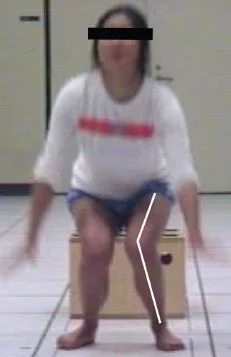
Higherup the chain, we then need to have a mobile hip joint so that we can run, andmove in multiple directions. As you cansee, the joints in the lower body go mobile-stable-mobile.
Ina perfect world, these three parts work together. But, as we all know, nothing is ever perfect.If you’ve lost mobility in either the ankle or the hip, you knee is going tohave to make up for it, and a stable joint will become unstable. Often times, these changes are ever soslight, but it can develop into some serious knee pain that would have you choose to get stabbed in the face with a fork, rather than embarking for a 2 mile run. (Those that have had knee problems will knowwhat I’m talking about.)
Now,let’s look at this study, which focuses the problem on the kneecap. The authors took MRIs of knees when they were flexed and extended. What theyfound is that the kneecap doesn’t move or “track” in a certain direction. Instead, its your knee cap that moves around your femur and tibia (the twobig bones in your leg). Suddenly, you can see how decreased rotation and movement (or too much of either)can throw off this entire mechanism.
Now,if you’ve made it this far in my blog post, I must congratulate you. This information is some pretty heavy stuff,and if you’ve managed to pick up some of what I just threw down, give yourself apat on the back! If nothing else, justremember that if you have knee pain, strengthen those glutes and abductors.
Remember: you can ice your knee all you want, but you’reprobably just mopping up a wet floor…when it’s the ceiling that’s leaking.