
It’s
time to bust a myth. This time, I’ve got
my crosshairs on one of the most fabled exercise components of all time –
static stretching. For a quick clarifier,
static stretching is when you’re either sitting or standing, and in a fixed
position for longer than a few seconds to “stretch” your muscle.

Between the alcohol, the steroids, and the concussion, I’m not quite sure how this guy is still alive.
Now,
why do we stretch? Is it because it
feels good? I’d have to say that what
“feels good” depends largely on the body part.
In fact, I seriously contemplate headbutting a concrete wall (like The
Situation on Jersey
Shore) so that I don’t
have to stretch my hamstrings.
So,
then, we must static stretch to prevent injuries, right? RIGHT!?
Well, it turns out that’s not true.
A quick search on PubMed will yield a long list of literature that
illustrates that there really is no
correlation between static stretching and injury rates. (If you want to get
your nerd on, you can check here, here and here) If you think about when muscles strains
occur, they almost always occur in a normal range of motion. If that’s the case, how would an increased
range of motion prevent those
injuries?
Let’s
examine what static stretching ACTUALLY does.
What you’re trying to do is lengthen a muscle that you think is short or
tight. But, how do you know the muscle
is actually the target of your stretch?
You could instead be putting force on the passive structures such as
tendons or joint capsules (yikes!).
While there’s difference in opinion on how long the effect of stretching
tends to last, it’s generally accepted that within an hour your muscle will be
back to the same length.
Now,
what if you have “tight” hamstrings?
Well, most often, the muscle is NOT short. Instead, the muscle has neuromuscular
tightness, which simply means that your brain is telling that muscle to be
turned on in order to protect yourself.
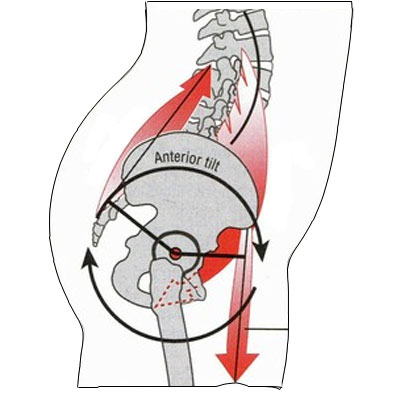
Anterior pelvic tilt at it’s finest..
Let’s
say that you have crazy anterior pelvic tilt, which is a fancy way of saying
that you tend to have a permanent arch in your lower back that makes your butt stick
out more than other people. For those
with this type of pelvic tilt, your hamstrings are going to be tight in order
for you not to crumple up into a ball of fail, and keep your pelvis in a
*somewhat* correct position.
Lastly,
there’s a ton of evidence that performing static stretching actually decreases your power
output, compared to those who don’t. I’m
not sure about you, but I like to throw some weight around in the gym, and
often want as much strength and power as possible.
So
if you shouldn’t stretch, how does one warm up before going on a run, lifting
weights, or playing a sport? Well, it
should be by doing an active and dynamic warm up, where you go through your
ranges of motion while moving your entire body.
Next, some specific warm ups to your activity are in order, as that will
be much more specific and efficient than just stretching your hamstrings.
To
be clear (and a bit of a hypocrite), I do believe that there probably is some
role for static stretching, but I see it more as a corrective exercise than for
injury prevention. Also, you need to fix
the kink in the chain that was the reason you were “tight” in the first
place. For example, I would follow up
some hamstring stretches with some core work (since I believe that’s the real
reason why my hamstrings are tight), followed by some good deadlifts which should
“lock in” that newfound range of motion.
Think
about it like this: if you like to stretch, you can definitely do it. But, realize that you’re probably wasting
your time. If you can touch your toes,
spend all of that time you used to stretch to simply get stronger.

Alex Tankskey is the founder of The Movement Lab. A former marketer and Facebook surfer, Alex changed careers when he experienced how strength can transform your life. He's now a Strength Coach under the National Strength and Conditioning Association (NSCA), StrongFirst (SFG1), Functional Movement Systems (FMS), and a certified Precision Nutrition Coach (Pn1).