
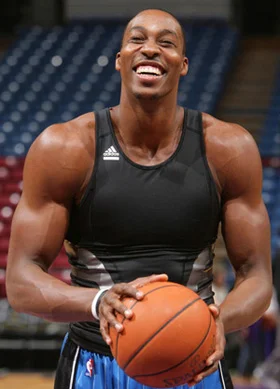
Dwight Howard – now he has experienced some serious hypertrophy
Just
the other day, someone asked me if I had a man crush on Dwight Howard’s
shoulders. The answer? Why yes, yes I do.
Now,
let’s not go off the deep end, as I think he’s completely overrated and the Kim
Kardashian of the NBA (famous for never really doing anything). But, attaining “Dwight-caliber” shoulders
will remain a pipe dream for the majority of Americans. The reason?
They already have a bad shoulder.
It’s
important to start off by saying that there are tons of problems that can occur in the shoulder. But as I wrote
here, focusing on the joint that hurts can be somewhat of a misguided approach,
since the painful joint may be doing everything correctly. In the case of the shoulder, the culprits for
shoulder pain can often be a bad thoracic spine or scapula.
As
I’ve written about the joint-by-joint theory in one of my previous posts, I
want to briefly touch on how this theory of “mobile levers on stable joints”
relates to the upper torso.
If
we think of the upper back, or thoracic spine, you’re supposed to be relatively
mobile. Think of any type of athletic
move (such as a golf swing, a baseball pitch, etc.) and you’ll see that there
is a ton of extension/rotation that occurs through the upper back. In fact, to understand how important this
concept is, try to do anything athletic while doing an impression of the Hunchback of
Notre Dame. Safe to say, it’s going to
be awkward.

I don’t think it’s a stretch to say that this cartoon probably had his fair share of shoulder issues..
Next,
we come to the scapula, otherwise known as the shoulder blade. According to the theory, this area needs to
be stable. Why? Because unlike the hip, which has a nice
fitting of the femur into the socket (which nerds will refer to as the
acetabulum), the shoulder is a joint that’s really just a bunch of bones all
wrapped together. If you take away the
scapula when it should be stable, we can liken it to taking away part of your
hip socket. If that happens, your shoulder will spontaneously burst into a
flaming ball of failure.
Finally,
we get to the shoulder joint, which needs to be mobile in order to reach for
anything or throw a baseball. While I
won’t get into the specifics of shoulder/rotator cuff mechanics yet, it’s
important to point out that any kink in the chain can really complicate matters
up here. If you don’t have great t-spine
mobility, your scapulas will not be able to get stable in the right position, and
your shoulder will not have a sufficient base of stability in order to be
mobile.
Still
with me? I hope so, because now let’s
get into how you can really fix that cranky shoulder…
First
up, you have to make sure you can breathe correctly. You may be saying “What the what!? I need to breathe? I’m pretty sure I know how to do that, since
um…I’m still living, AND BREATHING!”
Well, that’s true, but it doesn’t mean you’re doing it correctly.
Our
bodies are extremely talented at compensating for movements and patterns. Since breathing will always trump everything
else as priority #1, we may have picked up some inefficient breathing patterns which can naturally occur from sitting in a desk all day or in other
positions. (As a quick test, take note of
how you’re sitting. Now, switch
positions entirely so that you’re a mirror image, just on the other side. My bet is that you’ll feel a bit
uncomfortable in the second position).
Below
is a quick, 2 minute video on breathing patterns that I put together the other
day, with a few notes below:
Now,
I just want to quickly return to why breathing is important. As I mentioned in the video, bad breathing
patterns can “turn on” muscles that we don’t necessary want to have “on” when
we breathe. How this relates to shoulder
mobility is that if you’re properly maximizing the diaphragm and your deep
abdominals, these muscles will begin to do their job, which will “dim” or “turn
off” the muscles in your upper torso that were doing the brunt of the breathing
work. Once that happens, then we can
really start to get your mobility back!
Check
back next week for part 2, where I’ll show you the next step to regaining
mobility and fixing that shoulder!

Alex Tankskey is the founder of The Movement Lab. A former marketer and Facebook surfer, Alex changed careers when he experienced how strength can transform your life. He's now a Strength Coach under the National Strength and Conditioning Association (NSCA), StrongFirst (SFG1), Functional Movement Systems (FMS), and a certified Precision Nutrition Coach (Pn1).