
I’m a pretty big nerd. I know, that’s not a shocker to many of you (or….all of you) as my references to academic studies, jokes about the Prowler and the coefficient of friction, as well as my insatiable hunger for great 80’s music have blown up my spot.
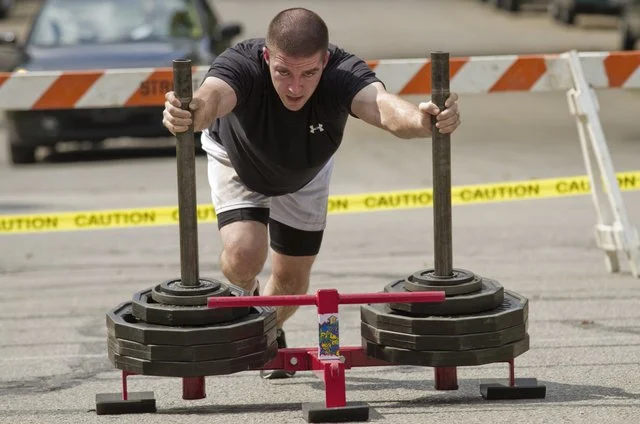
If you’ve never been out of breath from the Prowler, it’s hard to explain..
All that’s to say that while I may dream of picking up 500 pounds, if you prick me, I’ll still bleed from the barbell all the way back to my iPad filled with textbooks.
It comes as no surprise then that whenever I hear about an interesting, nerd-tastic study riddled with regression slopes and standard deviations, my ears perk up a lil’ bit. Such was the case a few days ago, when I came across this running related study that had an interesting message for anyone looking to lose weight by running – almost all of the runners in the study gained weight as they aged, regardless of their weekly mileage. In fact, even if someone averaged 40 miles a week, they still packed on the pounds as the years went on.
You know the only way some runners actually lost weight? That’s right, more running….and they had to run at least twice or three times as many weekly miles as they had previously recorded.
Of course, it’s important to point out that age-related weight gain is to be expected among the population. In fact, it’s why we all shake our fists angrily at 18 year olds, saying “how you can eat that!?” But, it’s notable that running simply couldn’t do the job of curbing that age-related weight gain.
Running is often seen as a symbol of athleticism and is the default “how in shape are you?” test. But, if running to lose weight only begets more running (and we know almost everyone that runs will inevitably get hurt), is this really a winning proposition? I don’t think so.
Before I had even come across this study, however, I’d noticed a very similar and anecdotal trend: the more one runs or increases their weekly mileage, the more likely their body fat percentage (regardless of scale weight) tends to rise.
Boom….I’ve just dropped the bomb on all of you, a la The Gap Band:
There’s just so much about this video that I can’t handle – the boy band style dancing, the sequined cowboy hats, the neon shadows, the relentless finger pointing. You can thank me later for bringing this song and video into your life 😉
Anyway, back to the matter at hand.
Let me clarify my statement above – in my experience, those that increase their mileage for any number of reasons (for fun, an upcoming race) tend to see an increase in their body fat percentage, even if their scale weight decreases. What gives?
In some ways, this observation really isn’t all that different from the study I mentioned. When our bodies try and adapt to running, we cleverly attempt to make our capillaries as close together as possible. For many of us, that means we need to trim ourselves of excess weight….usually by means of losing what we don’t use (read: muscle). Then, when body composition changes, it fundamentally alters the way our metabolism works. Even if you’re at a lighter scale weight, as your body fat percentage rises and the percentage of muscle decreases, you’re apt to put on weight when the running is cut back or when you begin to adapt to your normal mileage. Muscle requires many more calories than fat, and the more muscle you have, the more calories you’re going to burn everyday.
OK, now onto the title of this post: does running really help with fat loss? The answer is a big, unsexy “it depends.” But, can it change your body composition and are there better options out there for losing weight? Youuuu betcha.

If you’re looking to lose weight and have turned to running, I’d suggest reexamining the following three points:
And besides, heavy squats build character.
If running is your sport, then there’s really no need to worry about gaining weight. As I always tell everyone, focus on one goal at a time. If that’s a particular race, do well in that race and worry about your body fat at a later date. But, if you want to lose weight, then the formula remains the same: eat well and lift some heavy things.

Alex Tankskey is the founder of The Movement Lab. A former marketer and Facebook surfer, Alex changed careers when he experienced how strength can transform your life. He's now a Strength Coach under the National Strength and Conditioning Association (NSCA), StrongFirst (SFG1), Functional Movement Systems (FMS), and a certified Precision Nutrition Coach (Pn1).