
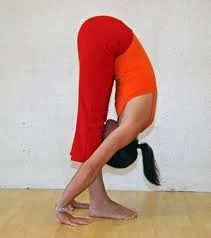
Dysfunctional? Yes. Hypermobile? Yes. But as someone who got a zero on the “Presidential Fitness” test, am I impressed? You betcha.
As
you can probably tell, many of my blog posts arise out of various conversations
I have with clients, coworkers, and the various people I see everyday. Today is no exception, as one of my clients
and I spoke about how it’s easy to spot someone that’s “stiff” and immobile,
but is there ever a problem with being too flexible?
The
answer? Yes! Being too flexible is actually a problem, and
while it may not be as easy to spot, it can lead you down a similar path of
pain and dysfunction.
For
example, if someone can palm the floor with their hands while standing, I would
say that’s actually dysfunctional. Why? Because we’re only supposed to touch our
toes, and anything more than that means you’re getting that extra motion at the
expense of something else.
Let’s
break this down into smaller pieces so that it’s easier to digest. On one end of the spectrum, you have
individuals that are so tight and locked up, that bending down to touch their
toes is probably a workout in itself.
For these tight individuals, stretching is probably needed in some
capacity. On the other end, you have the
people that would rather be stretching than doing any other physical activity
(and yes, I’m betting you know some people that are like that).

I’d like to say Ben Affleck redeemed himself for making “Argo”…but, well, I’m not quite there yet.
Going
back to the joint-by-joint theory (which is based on the theory of mobile
levers built on stable segments), you can easily see that if someone can palm
the floor, they may be displaying great hip mobility….but that may be coming at
the expense of what’s supposed to be a “stable” lumbar spine.
You
only need so much mobility. After that, it’s
like having a signed poster of “Gigli”…you’ll experience diminishing returns.
The
same is true with the shoulder. I’ve
seen many people that show great shoulder mobility on a given test, but they
writhe in pain if you put them in a position where their rotator cuff has to
actually go to work. Clearly, they have
too much mobility and need to work on controlling it so they can stay pain-free.
Do
you like to stretch? Then you probably
don’t ever need to. Don’t like to
stretch? Well, then you probably
should. And, in both cases, you should
build some additional stability through picking up heavy things, and then
putting them down.

Alex Tankskey is the founder of The Movement Lab. A former marketer and Facebook surfer, Alex changed careers when he experienced how strength can transform your life. He's now a Strength Coach under the National Strength and Conditioning Association (NSCA), StrongFirst (SFG1), Functional Movement Systems (FMS), and a certified Precision Nutrition Coach (Pn1).