
If you were to look at the Testimonials section on my website, one of the areas I’ve excelled in training is the ability to help people get out of pain. Despite that shameless self promotion, I want to make it clear that I’m not a physical therapist. And I’ll often refer out to more skilled physical therapists when the situation arises.
I do, however, have a unique understanding of the human body and how every joint is intertwined. When someone experiences back pain, it could stem from daily habits and poor movement. Or it could really stem from poor airflow management and an inability to fully exhale.
Yeah, this just got deep.
The reason I bring this up is that as human beings, we like to place questions and answers neatly into buckets. Knee pain? Just wear a brace. Shoulder pain? Use a lacrosse or tennis ball and it’ll temporarily solve the problem.
The more I learn about the human body, however, there are so many reasons why someone may experience pain or issues at a specific joint. The following post by Michael Mullin really caught my attention, because he illustrates how many factors can go into the loss of a mobility at a joint – in this case, the ankle. (And in case you didn’t know, dorsiflexion is the act of pointing your toes to your knee. Being able to properly dorsiflex is imperative to squat correctly, as well as running and walking without compensating in other joints.)
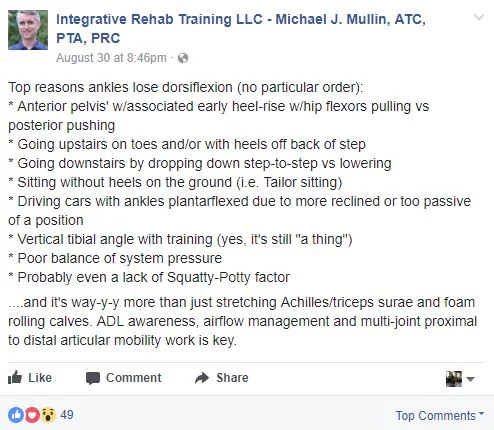
Even if you needed the help of Google to make it through that post, you can understand how many factors might be affecting a given joint.
To give you an actual example, let’s take someone with really long hamstrings (who can palm the floor) who has some ankle mobility restrictions. These two factors tend to go hand in hand, and it really has nothing to do with the hamstrings or the ankle. If we dig deeper, we’ll often find that this type of person has a weight shift issue (reasons #1 and #7 in the above post), where they’re shifted too far forward anytime they’re on their feet. In a sense, they’re constantly standing on a ski slope facing downhill, and what results are calves/Achilles/plantar flexors that can’t shut off or relax. Stretching their calves or Achilles may help with symptoms, but it doesn’t fix the underlying cause, often exacerbated by all the other reasons stated above. Worse yet, this forward shift will often rear its ugly head whenever this person squats or deadlifts.
The last example is when people foam roll or use a lacrosse ball to treat their soft tissue. Many times, this type of intervention will help someone feel better – I’m not questioning that. What I do question is what’s making that area tight or sore in the first place? And why is it just as sore or tight the very next day? Most often, it has nothing to do with whatever body part is being treated. It usually has everything to do with how someone manages air and the position of their thorax and pelvis.
It’s outside the scope of this post to give general recommendations on how to help individuals with mobility restrictions or painful joints. And the key to all great exercise programs is individualization. Think globally, not locally.

Alex Tankskey is the founder of The Movement Lab. A former marketer and Facebook surfer, Alex changed careers when he experienced how strength can transform your life. He's now a Strength Coach under the National Strength and Conditioning Association (NSCA), StrongFirst (SFG1), Functional Movement Systems (FMS), and a certified Precision Nutrition Coach (Pn1).