
Not
long ago, I was a pitcher in college and thought I knew everything about
strength and conditioning. Oh, how wrong
I was.
Since
my career change, I’ve often thought back to my high school and college career
and how I would have tweaked my own training to be tailored to
pitching. It should go without saying
that I know a lot more now than I used to, but by no means am I the “know-it-all”
I was before.

Now,
before I go on, I need to preface by stating that some of what I’m going to say
will fly in the face of baseball traditionalists – many of whom believe that
lifting weights will get a pitcher bulky, and that running in between starts is
the best way to “stay in shape.” Details
about hypertrophy and metabolic demands aside, I hope you can keep an open mind
if you’re among this traditional baseball crew.
Also,
if you haven’t noticed by now, I tend to like lists, as it makes
everything *appear* more efficient. That
said, here are my first two lessons to my former self:
Stop Running and Lift
More –
Every season tends to have its ebb and flow, but looking back, every season of
mine from high school to college had the same peaks and valleys. I’d start off the season really well and
throwing with good velocity for myself, but then I’d end every season with
barely any strikeouts and getting bounced around in my last few starts. Now, there’s a ton of variables that could be
responsible for falling apart as the season wore on. For one, I may have just been getting
fatigued with each start, and there’s been studies that illustrate that
the number of pitches thrown will incrementally increase their ERA throughout the season. Another reason could simply be that hitters
get better as the weather warms up and they receive more and more exposure to live pitching. But, I venture to say that it was running for
25-30 minutes the day after every start for why I was becoming less and less
effective.
“Wait,
I thought pitchers were supposed to run?
Doesn’t it flush out the lactic acid in your shoulder?”
This
theory and common misperception among baseball traditionalists is flawed in
every single way. First off, lactic acid
is not responsible for muscle soreness.
In fact, lactic acid is actually fuel for your body, and the only reason
it was once thought to cause soreness has to do with some crazy scientist that
experimented on frogs by shocking them and taking blood samples…and no, I’m not
joking. While I won’t bore you with the
details, here’s a nice little article that explains it in more detail.
Next, let’s touch on the SAID principle (specific adaptions
to imposed demands). If you compare long
distance running and pitching, they are completely different animals. One requires short, 2-3 second repeated
bursts of high intensity with recovery of 15-20 seconds, and the other requires
low, steady intensity of 20-30 minutes.
When put this way, there doesn’t seem to be a whole lot of carryover, does
it? Running will sap your power as your body adapts to it.

The five worst words you can say to a pitcher: ”Okay guys, go run poles.”
In a study that came out a few years ago, 16
Division 1 college baseball players were divided into a cardiovascular
endurance training group (ahem, running) while the other half were placed in a
speed group. During the
season, those that were in the cardiovascular endurance group saw significant decreases in power, while those that
participated in speed training saw immensely improved power production. While no study should be treated as fact, it can be theorized that speed training
and weight training would definitely improve (or maintain) levels of power…which is what you want if you’re a pitcher!
No Overhead or
Barbell Lifting – While I was lucky to never really be affected by any
shoulder problems, I was in the minority on my college team. Many of my teammates were often performing military presses, upright rows, barbell
bench pressing, and a few others. Of
course, we knew nothing about glenohumeral instability, or how our body had
adapted from throwing a baseball for 18 years.
The problem with many of these exercises is that it requires
a ton of shoulder mobility, and those that play overhead sports often have
asymptomatic shoulder issues. This study
found that 79% of asymptomatic professional pitchers had abnormal labrum
features. It doesn’t take a fancy degree to tell you
that if you have instability in this region, the risk/reward of overhead
pressing is not in your favor.
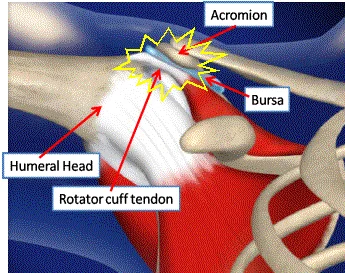
Plus, exercises such as upright rows require thoracic spine
mobility, and great control of your rotator cuff to prevent shoulder
impingement. While I’ll dig into this
topic in a few more weeks, the picture below illustrates that if your rotator
cuff isn’t preventing superior glide of your humerus, it will impinge on your
supraspinatus (one of your 4 rotator cuff muscles), causing you pain.
As you can probably tell, I had a lot of fun writing this
one, and I’ll be back in a few days with Part 2….which hopefully won’t be as long!

Alex Tankskey is the founder of The Movement Lab. A former marketer and Facebook surfer, Alex changed careers when he experienced how strength can transform your life. He's now a Strength Coach under the National Strength and Conditioning Association (NSCA), StrongFirst (SFG1), Functional Movement Systems (FMS), and a certified Precision Nutrition Coach (Pn1).