
I
hate sit-ups. I really do. And, if I
haven’t made that clear by now, then you probably don’t know me very well.
So,
it must come as no surprise that after I go on my weekly rant about why I hate
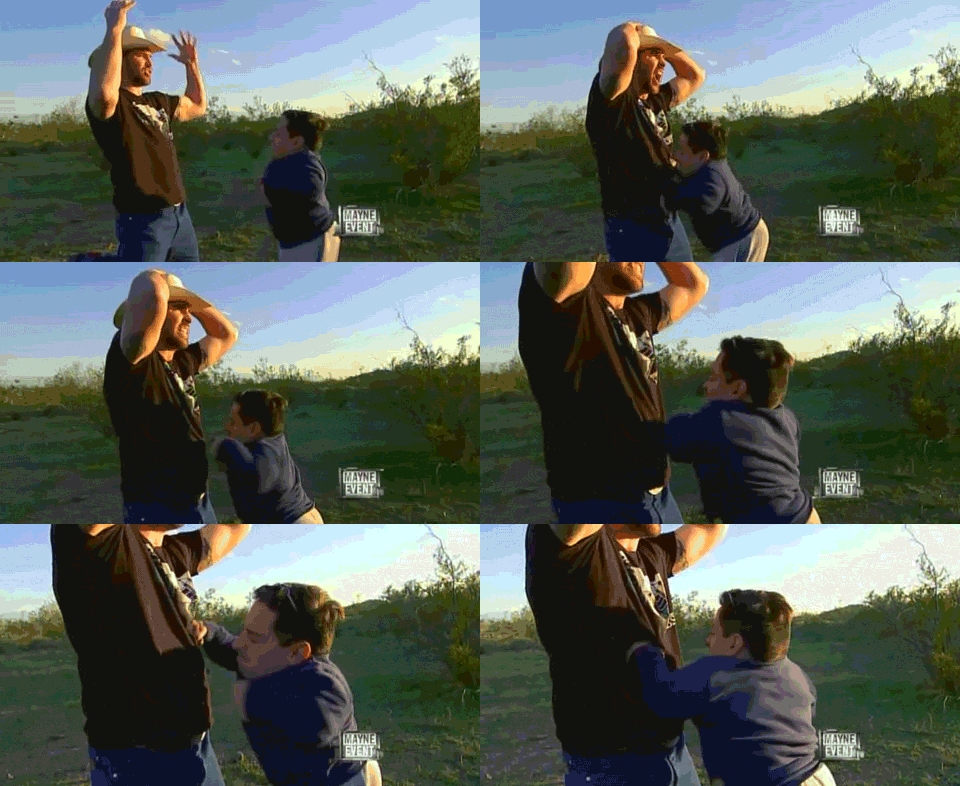
sit-ups, I often get asked “what do you do to train your core instead?” While I usually start by having midgets punch
me in the stomach, there are a few other things I tend to incorporate.
Before
I move on, its important to state why sit-ups are a terrible idea. As I stated in this post, research conducted
by Dr. Stuart McGill has shown that sit-ups are one of the best ways to give
yourself a herniated disc. Furthermore,
thinking about your core as only your rectus abdominus (the muscle that makes
Channing Tatum have awesome abzzzz), is misinformation that we’ve been fed
through various media.
Instead,
you need to think of your core as much more encompassing of all the muscles
that make up your stomach and back. If
you only train those muscles doing sit-ups, then you’ll be very good at a bad
exercise. What you need to do, is train
these muscles to prevent rotation or movement, in a dynamic fashion.
Before
we get there, the first thing you need to do is teach yourself how to brace
your core. This means to start in a
“dead bug” position, which I’ve demonstrated below. There are plenty of progressions and
regressions from this position, but your lower back should not be coming off the
floor at all, and you should only feel this movement in your stomach.
Once you’ve done that,
it’s time to move on to your standard plank. You can start doing planks from your knees, rather than toes to make it a bit easier. The important cues you want to focus in on are to be bracing (or squeezing) your abs as well as your glutes. Ideally, you want a straight line
from your head down to your feet. While
I may not be demonstrating that in this video, I argue that for me, my pelvis is in the correct position as I’m properly bracing, and having my hips up higher makes me unable to squeeze both areas. That’s just me. But, on to the video!
Next, side planks are in order. Once again, you could do these from your knees to make them easier, and Stuart McGill says that a proper side plank should only last 15 seconds. After that, compensations start to kick in, and you can probably tell how I start shake just seconds into the video. Like many other things, it’s easy to make them look right, but tough when you do them correctly.
After
you’ve mastered that, bring in some valslide action! These are called bodysaws and are tough. You could also progress these by only having
one foot on the ground, adding some weight on your back, etc.
After all that stuff, it’s time to do some heavy duty core training with weights. Below are farmer’s carries which are very, very under appreciated. If you take a simplistic view, you’ll think we’re training grip and pure strength. A more encompassing view will illustrate we’re training your entire core musculature in a dynamic movement. Note how my shoulders are back, but I’m squeezing my stomach so that my ribs aren’t flaring up. As the legend Dan
John has made clear, there’s something about carrying heavy stuff that’s just pretty awesome.
Lastly,
we have an anti-rotation exercise which will seem pretty easy, but is actually quite difficult. You’ll see in the video below that I do this from tall-kneeling. Why?
Because we need to build stability in this position first, as it takes
out all the extraneous limbs and moving parts.
Also, I’ve had a tough time getting people stable in even this
position, so moving onto anything else is moot. Anyway, here’s the last
video:
Hopefully you learned something, because this blog post suddenly became a bit….epic. Anyway, try to incorporate a few of these next time you’re in the gym, and let me know what you think!

Alex Tankskey is the founder of The Movement Lab. A former marketer and Facebook surfer, Alex changed careers when he experienced how strength can transform your life. He's now a Strength Coach under the National Strength and Conditioning Association (NSCA), StrongFirst (SFG1), Functional Movement Systems (FMS), and a certified Precision Nutrition Coach (Pn1).